
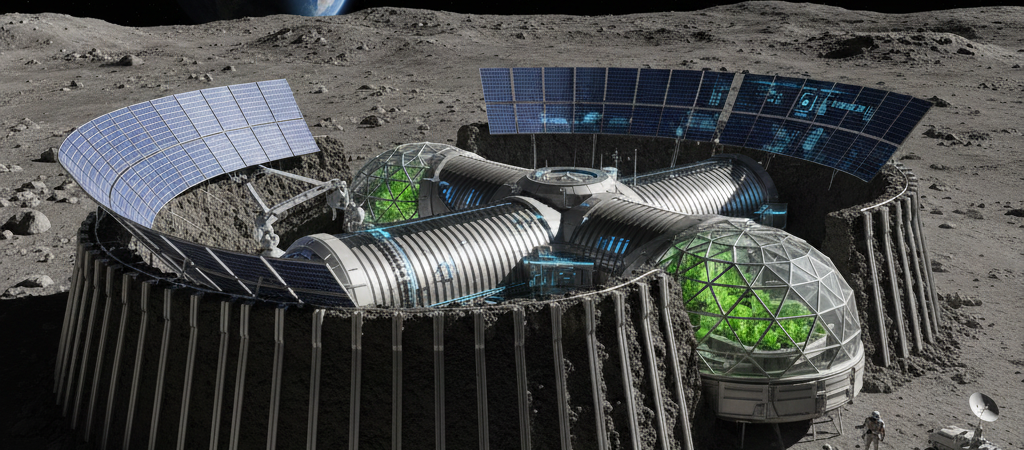
A new era of space exploration is beginning with the unveiling of the next-generation lunar habitat. Designed for long-term habitation, this modular system utilizes advanced 3D printing technology and local lunar materials.
Context and Importance of Lunar HabitatsWith renewed global interest in lunar exploration, especially under programs like NASA’s Artemis, the design of next-generation lunar habitats is critical. These habitats will support long-term human presence on the Moon, enabling scientific research, resource utilization, and preparation for deeper space missions.
Design Philosophy and Challengesa.
Environmental ChallengesExtreme Temperatures: Lunar surface temperatures vary drastically, from about +127°C during the day to -173°C at night.Radiation: The Moon lacks a protective atmosphere, exposing habitats to cosmic rays and solar radiation.Micrometeorites: The habitat must withstand impacts from small space debris.Regolith Dust: Lunar dust is abrasive and can damage equipment and pose health risks.b. Structural and Material ConsiderationsUse of regolith-based shielding (e.g., 3D-printed lunar soil structures) to protect against radiation and micrometeorites.Lightweight, expandable modules for transport efficiency.Integration of transparent materials or domes for natural light while maintaining protection.Modular designs to allow habitat expansion and reconfiguration.
Next-Gen Lunar Habitat Featuresa.
Expandable and Modular DesignsHabitats that can be compact during transport and expand on the lunar surface.Modular units for living, laboratories, agriculture, and storage.b. Self-Sustaining Life SupportAdvanced recycling systems for air, water, and waste.Hydroponic or aeroponic agriculture modules for food production.Energy-efficient systems powered by solar panels or nuclear sources.c. Smart and Autonomous SystemsAI-driven environmental controls to maintain optimal living conditions.Autonomous maintenance and repair robots.Real-time health monitoring for inhabitants.d. Integration with Lunar InfrastructureCompatibility with lunar rovers, power grids, and communication networks.Designed for ease of assembly by astronauts or robotic systems.
Examples of Current Concepts and PrototypesExpandable Habitats:
Concepts like Max Space’s expandable lunar habitats focus on lightweight, inflatable modules that can be deployed quickly.3D-Printed Regolith Structures: NASA and other agencies are experimenting with using lunar soil to print protective walls and domes.International Space Station (ISS)-Inspired Modules: Some designs mimic ISS units but adapted for lunar conditions.Agricultural Modules: Self-sustaining greenhouses to support long-term food production.
Future Outlook and Research Directions
Continued testing of habitat prototypes in lunar analog environments on Earth.Development of materials and construction techniques suitable for the Moon.Integration of AI and robotics to reduce astronaut workload.Exploration of underground or lava tube habitats for natural protection.